

By the early Fifties, it was clear to smaller automakers that the “Large Three” (Basic Motors, Ford, and Chrysler) had been taking part in for retains, and that impartial automobile manufacturers had been simply preventing for market-share scraps.
Impartial Carmakers
Whereas the bigger carmakers appeared to stumble briefly when post-war manufacturing resumed, it wasn’t lengthy earlier than nearly half of all American new vehicles had been coming off of Chevrolet and Ford heaps. Smaller makers realized that to stay even considerably aggressive, they wanted to use market niches ignored by the Large Three.
Small Automobiles
And thus, Nash launched the Metropolitan, a really small automobile bought for a really cheap sum of money. Nash was, on the time, among the many extra prolific impartial carmakers, with a lineup of conventionally dimension fashions, in addition to Rambler fashions, the latter of which had been forward of their time, heralding the early Sixties arrival of such fashionable compact vehicles because the Dodge Dart and Ford Falcon.
Nash and Austin
The Metropolitan was a lot smaller than the Rambler, and its growth was one thing of a threat for a small automobile firm. To chop growth prices, the Metropolitan was designed within the U.S., however manufactured by British carmaker Austin, utilizing parts of automobiles already in manufacturing for European markets, together with the engine.
Introduction
Launched in 1954, the Metropolitan was significantly smaller than the Rambler, however featured acquainted American design cues. From the get go, the brand new tiny Nash was supplied each as a convertible, and hardtop coupe.
Specs
 The Metropolitan got here in absolutely 26 inches shorter than the already tidy Rambler coupe, and although technically geared up with a rear seat, no sane passenger would voluntarily enterprise into the restricted house aft of the front-row seats—particularly within the convertible.
Energy, too, was restricted. Early Metropolitans had been geared up with a 42-horsepower 1.2-liter Austin 4-cylinder engine. The engine would later be bumped to 1.5-liters and 55 horsepower. A buff-book assessment of a 1954 instance quoted a 0-60 mph time of twenty-two.4 seconds. Gradual even by modern requirements.
Critiques
That stated, Metropolitan critiques had been largely constructive, with the automotive media discovering the little Nash sporty in character and enjoyable to drive. The automobiles had been additionally reportedly properly constructed, and simple to function.
Costs
For 1954, costs began at round $1500, about the identical worth as a like-year Volkswagen Beetle, and roughly $50 cheaper than the least-expensive Rambler, the Deluxe Sedan.
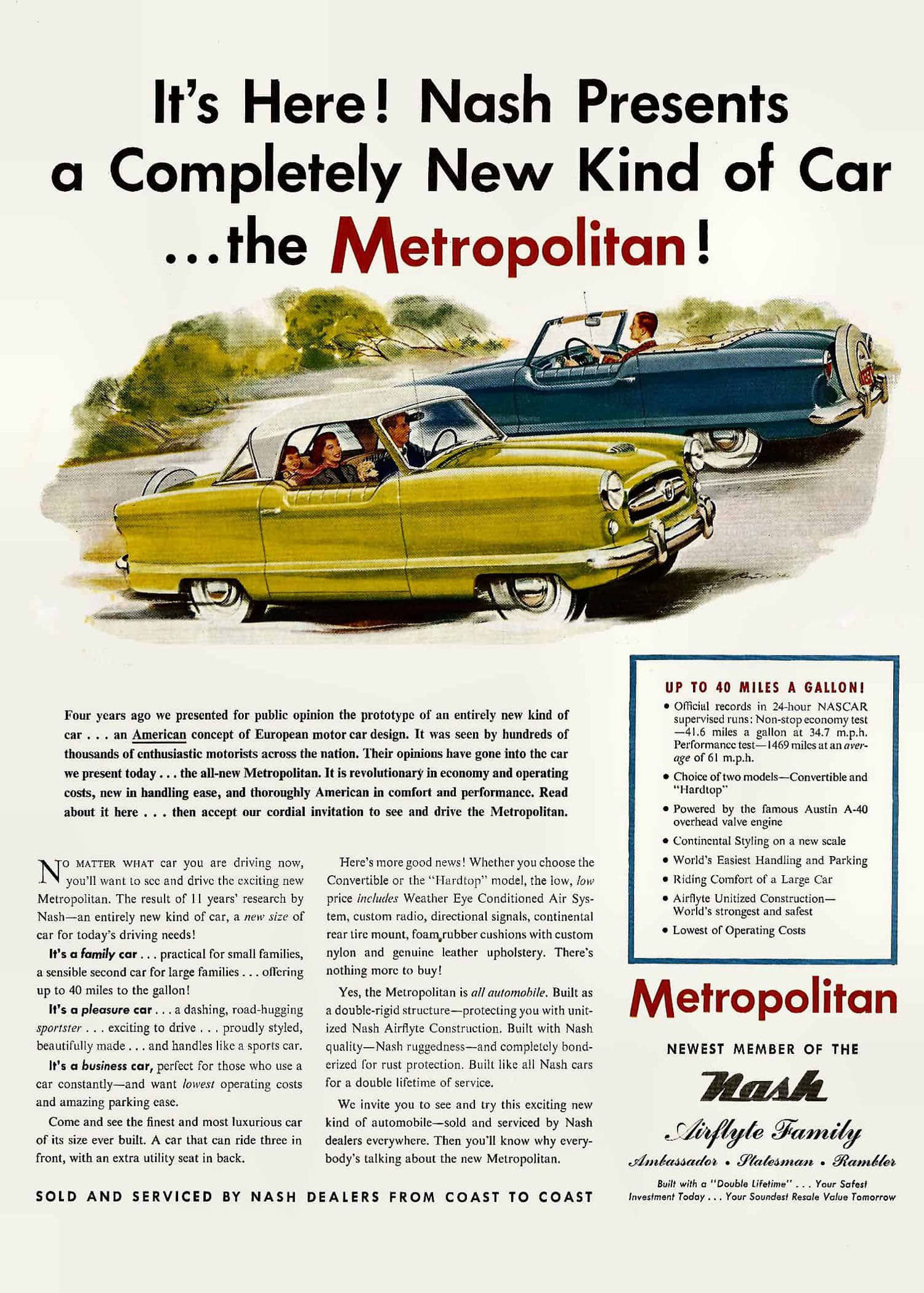
Print Advert
We admire this journal advert for its optimism relating to American prospects’ willingness to undertake really small vehicles as an alternative choice to bigger, less-efficient automobiles.
Gross sales
And on this level, Nash was half appropriate. Whereas the small Rambler was truly fairly fashionable, the Metropolitan by no means caught on. That stated, the little Metro bought higher than most people most likely assumed it would.
Nashed peddled greater than 11,000 Metropolitans in 1954, with gross sales peaking at higher than 20,000 models for 1959. Whereas these numbers had been rounding errors at Basic Motors, they had been truly spectacular for Nash, all issues thought of.
Finish of Manufacturing
Nash ended Metropolitan manufacturing after the 1962 mannequin 12 months. Apparently, different carmakers by no means actually realized from Nash’s Metropolitan efforts. People will purchase small vehicles, however won’t—for any sustained time frame–purchase really tiny vehicles.
Small Automobile Failures
Listed below are only a few examples of smaller-than-subcompact vehicles that made solely temporary appearances in U.S. showrooms:
Ford Aspire (1994-1997)
Pontiac LeMans (1988-1993)
Good ForTwo (2009-2019)
Subaru Justy (1988-1994)
Toyota Starlet (1981-1984)
CG Says:
Although a curiosity right this moment, the Nash Metropolitan was taken critically in its time. As steered within the advert seen right here, the little Nash possible served households properly as a low-cost second automobile, although might have confirmed much less fashionable with touring gross sales people—particularly these spending a lot time on the freeway.
Nash would find yourself being absorbed by the vortex of impartial automobile firms that grew to become American Motors, with the Rambler model having fun with a interval of success as a stand-alone model. As for the Metropolitan, the little vehicles are actually a lot wanted by collectors, and by most accounts are pretty straightforward to maintain operating.
Hearken to the Automobile Stuff Podcast
1954 Nash Metropolitan Version Footage
Click on under for enlarged pictures