


The works of Plato state that when people have an expertise, some degree of change happens of their mind, which is powered by reminiscence — particularly long-term reminiscence.
This modification is what Andre Fenton, professor of neural science at New York College, and Abhishek Kumar, assistant professor of cell and regenerative biology on the College of Wisconsin–Madison, are finding out on the Marine Organic Laboratory (MBL) in Woods Gap, Massachusetts.
“My life’s work is to know how minds function, and particularly to know reminiscence — not merely as a hint of the previous within the mind however as an estimate of the longer term that the mind is afforded,” Fenton stated.
The researchers have upleveled their mission by harnessing NVIDIA RTX GPUs and HP Z Workstations to visualise huge datasets and by integrating customized AI instruments and syGlass, a virtual-reality (VR) platform for scientific exploration.
This mission is moreover supported by grants from the Nationwide Institute of Psychological Well being and the Chan Zuckerberg Initiative.
A Neural Forest Uncovered
Reminiscence is the job of the mind’s hippocampus. This C-shaped construction, resembling a seahorse, is the primary focus of the MBL analysis group.
Fenton describes the cells inside the hippocampus as a forest, the place billions of neurons seem like tiny tree trunks and the traces coming off the trunks seem like leaves.
The crew is finding out a small portion of those “leaves” — representing protein markers: an extremely tedious job because of their size, at a few micrometer every. A researcher should search by means of the forest of mind cells to seek out the right protein markers, which make up solely about 1% of all protein markers within the hippocampus.
The researchers have been seeking to ease the method of finding out these proteins and what their various buildings could reveal about reminiscence encoding.
Gathering and analyzing sufficient 3D volumetric knowledge on protein markers was a bottleneck inside the mission till NVIDIA and HP applied sciences have been launched into the workflow.
“This can be a huge computational problem, and the HP and NVIDIA applied sciences have enabled us to do step one: seize, test and retailer the 3D picture knowledge,” Fenton stated.
Utilizing these applied sciences, the MBL researchers captured 10 terabytes of volumetric knowledge after which carried out human visual-quality inspections.
Understanding Reminiscence May Stop Neurological Ailments
The crew’s final aim of discovering the operate of reminiscence at a molecular degree can enhance analysis into the basis causes of mind ailments tied to neurocognition, equivalent to Alzheimer’s and dementia.
“Folks don’t usually consider reminiscence as a part of their psychological well being, however nearly all psychological dysfunction will depend on what your mind shops — the beliefs, the anticipations, the anxieties that you’ve and the issues that you just anticipate,” stated Fenton. “These are all completely different features of what occurs when you’ve a reminiscence, so nearly all neuropsychiatric sicknesses and manipulation rely upon this understanding.”
As a step towards fixing these large-scale issues, the researchers are how reminiscence is affected when proteins go to incorrect places within the hippocampus.
The crew can be inspecting the correlation between the construction and performance of mind cells by means of high-resolution 3D pictures curated and saved utilizing syGlass on the HP Z excessive efficiency workstation powered and supported with a number of NVIDIA RTX GPUs.
“If we will perceive how one thing is constructed, then if there’s an issue, we will dissect that and resolve it,” stated Kumar. “That’s what we’re making an attempt to do: perceive how we retain reminiscence, so if an issue arises, we all know repair it.”
Enabling Digital Actuality and Pupil Exploration
The usage of syGlass on the HP Z6 desktop workstation, operating on NVIDIA RTX GPUs, turned the researchers’ endeavor from a time-consuming operation into an interactive scientific exploration — splendid for high-school-student engagement.
“The HP-NVDIA-syGlass system lets us innovate by participating three high-school interns,” stated Kumar. “They’d an summary curiosity in our science, and we acknowledged that the syGlass digital expertise would possibly enthrall them. We have been proper.”
The researchers introduced these three curious college students into their lab this summer time to investigate the reminiscence proteins utilizing the VR headsets, which allowed for 3D visuals of the info.
Their job was to seek out the precise proteins that have been memory-related and label them as such. Whereas this will sound like a easy job, the interns needed to sift by means of a sea of billions of neurons to seek out only some thousand protein markers that have been related to the analysis.
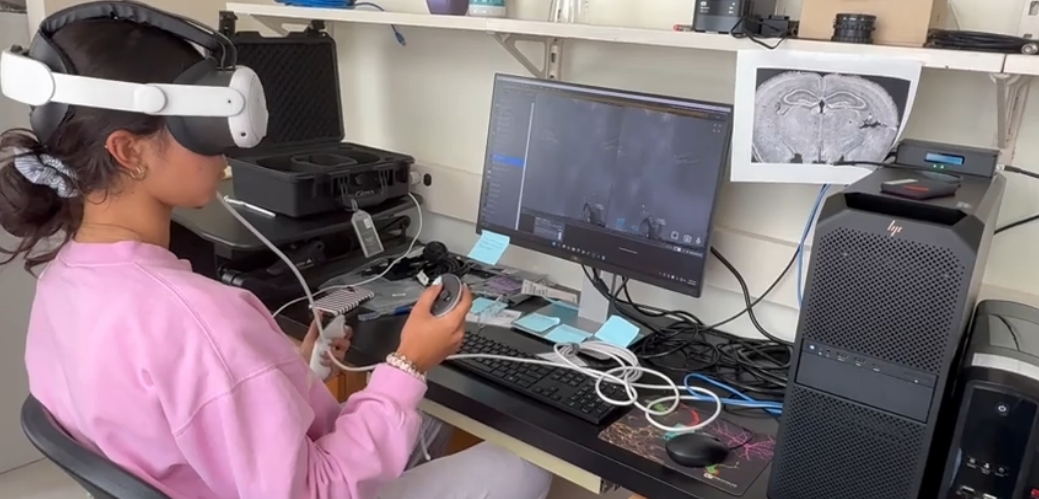
Because of the success of this pilot program, the crew is now seeking to develop high-school analysis alternatives for the mission.
“Why go away it at three college students?” stated Fenton. “Subsequent 12 months, it could possibly be 10 at a number of places serving to us find out about brains whereas they find out about brains.”
Be taught extra about NVIDIA-accelerated tutorial analysis.

